
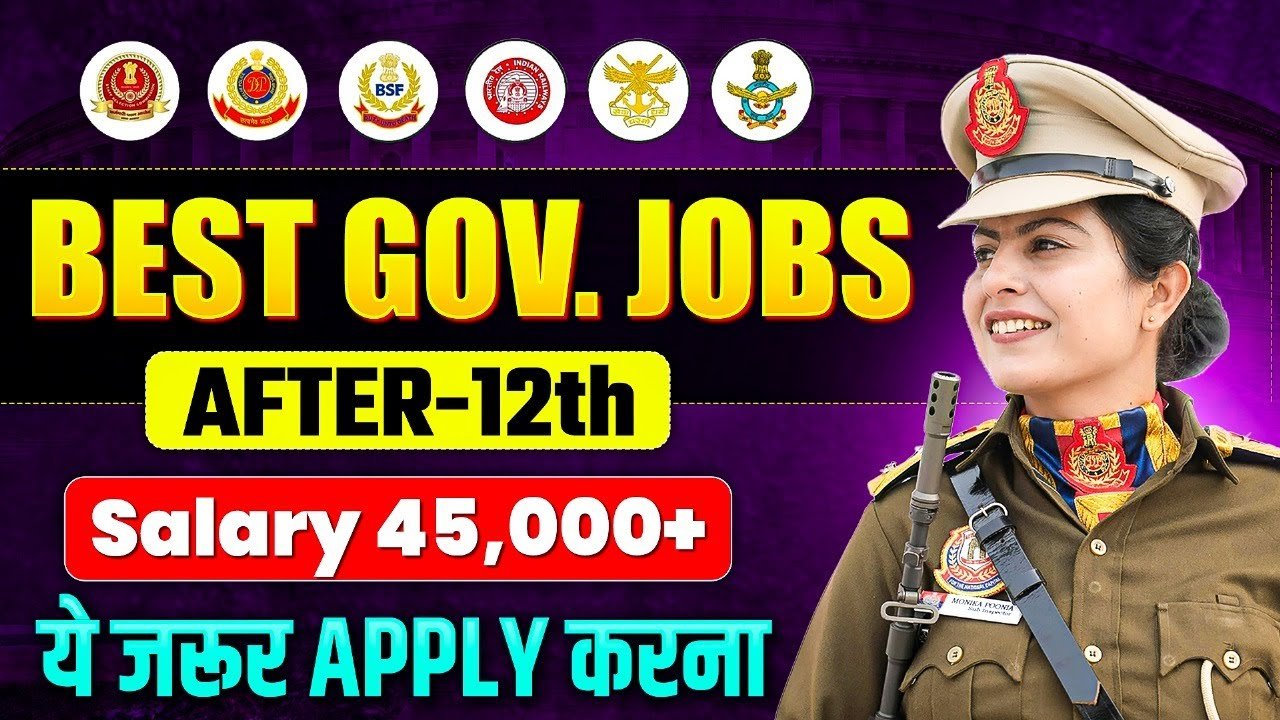
A World of Opportunity Awaits
Completing your Class 12 education is a significant milestone, and for millions of students across India, it also marks the beginning of the journey toward a secure and rewarding career. Government jobs, often referred to as “Sarkari Naukri,” hold a special place in the Indian employment landscape, offering stability, respect, and benefits that few private sector positions can match. The good news for 12th-pass students is that 2026 is shaping up to be an exceptional year for government recruitment, with thousands of vacancies across central and state departments waiting to be filled . From clerical positions in government ministries to prestigious roles in the defence forces, the opportunities are diverse and accessible. This comprehensive guide will walk you through the best government job options available after 12th, helping you understand eligibility requirements, selection processes, salary expectations, and how to prepare effectively.
Why Government Jobs Remain the Gold Standard
Before diving into specific opportunities, it is worth understanding why government employment continues to be the preferred choice for so many Indian families. The appeal goes far beyond the monthly salary. Government jobs offer unparalleled job security, with termination virtually impossible except in cases of serious misconduct. This security provides peace of mind that allows employees to plan their lives with confidence.
The compensation package extends well beyond the basic pay. Government employees receive dearness allowance, house rent allowance, medical benefits, and travel allowances that significantly increase their effective income. After retirement, pension schemes ensure a dignified life without financial worry. The work-life balance in most government departments is superior to private sector equivalents, with fixed working hours, generous leave policies, and national holidays .
For young people from modest backgrounds, a government job represents social mobility and family pride. It provides a platform for a stable life, enabling home ownership, quality education for children, and support for aging parents. These intangible benefits, combined with the tangible ones, explain why competition remains fierce even as the private sector offers higher starting salaries in some fields.
Understanding Your Options by Stream
The path you choose after 12th depends partly on the stream you studied, though many government jobs are open to students from all backgrounds. Science students have the widest range of options, including technical roles in defence and railways. Commerce students excel in banking and clerical positions. Arts and humanities students find welcoming opportunities in administrative roles and police services. The key is matching your qualifications and interests to the right opportunity.
Top Government Job Opportunities After 12th in 2026
SSC Combined Higher Secondary Level Examination
The Staff Selection Commission’s Combined Higher Secondary Level examination represents the single largest opportunity for 12th-pass students seeking central government jobs. Every year, lakhs of candidates compete for positions that offer respectable salaries and the prestige of working in central government ministries and departments .
The SSC CHSL exam recruits for several important positions. Lower Division Clerks and Junior Secretariat Assistants handle administrative tasks, document management, and office coordination across various government departments. Data Entry Operators are responsible for computer-based data management and processing. For certain specialized DEO positions in ministries like Consumer Affairs, candidates need 12th pass with Mathematics, while most posts are open to students from any stream .
The eligibility requirements are straightforward. Candidates must be between 18 and 27 years old, with age relaxation for reserved categories as per government norms. SC and ST candidates receive five years of relaxation, while OBC candidates get three years. Persons with disabilities receive additional relaxation ranging from 10 to 15 years depending on category . The educational qualification is simply passing 12th from a recognized board, making this exam accessible to students from all streams.
The selection process unfolds in multiple stages. Tier 1 is a computer-based test covering General Intelligence, General Awareness, Quantitative Aptitude, and English Language. This stage is qualifying in nature, meaning its marks are not counted toward the final merit list but candidates must meet the cut-off to proceed. Tier 2 is the main examination where merit is determined, with sections on Mathematical Abilities, Reasoning, English Language, and General Awareness. A Computer Knowledge Test is also conducted but is qualifying only. Finally, skill tests or typing tests are held depending on the post applied for .
The salary structure is attractive for entry-level positions. LDC and JSA posts come with a basic pay of ₹19,900 under Pay Level 2, which with allowances translates to approximately ₹25,000 to ₹40,000 per month depending on location. DEO positions start at ₹25,500 basic pay under Pay Level 4, taking home pay to between ₹30,000 and ₹50,000 .
The tentative schedule for SSC CHSL 2026 has the notification expected in April, applications open through April and May, and Tier 1 examinations conducted between July and September . Candidates should monitor the official SSC website at ssc.gov.in for exact dates.
Indian Railways Recruitment
Indian Railways is not just a transportation network but one of the country’s largest employers, regularly announcing thousands of vacancies that are ideal for 12th-pass candidates. The railway sector offers diverse roles with the romance of train travel and the security of a central government job .
For 12th-pass students, the most relevant opportunities include RRB NTPC for undergraduate posts. Non-Technical Popular Categories include roles such as Ticket Collector, Commercial Clerk, Junior Clerk, and Accounts Clerk. These positions involve passenger interaction, ticketing, and administrative support at railway stations and offices . The eligibility is 12th pass from a recognized board, with age limits typically 18 to 30 years depending on the specific post.
RRB Group D represents another massive opportunity, with over 22,000 vacancies announced for 2026 . These positions include Track Maintainer, Helper, Assistant, and various operational roles essential to railway functioning. While Group D posts are technically open to 10th pass candidates, 12th-pass students are certainly eligible and often have an advantage in the competitive examination . The selection process involves a Computer Based Test covering Mathematics, General Intelligence, General Science, and General Awareness, followed by a Physical Efficiency Test and document verification .
RRB ALP (Assistant Loco Pilot) positions are available for candidates with 12th pass in Science with Physics, Chemistry, and Mathematics, often combined with ITI qualifications. These are technical roles with responsibility for operating and maintaining locomotives .
The salary for railway positions varies by role but is generally attractive. Ticket Collector and Clerk positions offer approximately ₹30,000 to ₹50,000 per month including allowances. Group D employees start around ₹25,000 to ₹35,000, while ALP positions can reach ₹40,000 to ₹60,000 with allowances . Additionally, railway employees enjoy perks like free or concessional travel, medical facilities, and housing benefits.
Defence Services
For those with a spirit of adventure and a desire to serve the nation, the defence forces offer some of the most prestigious government jobs available after 12th. The Indian Army, Navy, and Air Force have multiple entry schemes designed specifically for young candidates who have just completed their schooling .
The National Defence Academy is perhaps the most prestigious entry route. Candidates who have passed 12th can appear for the NDA examination conducted by UPSC twice a year. Successful candidates join the Army, Navy, or Air Force as officers, receiving world-class training and a career of leadership and adventure. The age requirement is 16½ to 19½ years, and unmarried male candidates are eligible. For the Army wing, any stream is acceptable, while Navy and Air Force require Physics and Mathematics in 12th .
The Technical Entry Scheme is another officer-level entry for candidates with 12th Science (PCM) background. This scheme requires minimum 60% aggregate in Physics, Chemistry, and Mathematics, and candidates must have appeared in JEE Mains. Selected candidates undergo training at the Indian Military Academy and are commissioned as officers .
For those seeking to join as soldiers, the Agniveer scheme is currently the primary recruitment route. Under this scheme, young people between 17½ and 23 years serve for four years, with a opportunity for some to be retained in regular service based on performance and requirements . Multiple posts are available under Agniveer including General Duty, Technical, Clerk, and Tradesman positions. Educational qualifications range from 10th pass to 12th pass with specific subjects depending on the post.
Soldier General Duty positions require 12th pass with minimum 45% aggregate and 33% in each subject. Soldier Technical positions require 12th with Physics, Chemistry, Mathematics, and English. Soldier Clerk positions require 12th pass in any stream with English and Mathematics .
The selection process for soldier entries involves online registration, physical fitness tests including running, pull-ups, and balance exercises, medical examination, and written examination covering general knowledge, numerical ability, and reasoning. Successful candidates receive training and are posted to various Army units .
Salaries in the defence forces are attractive and come with numerous allowances. Agniveers receive a monthly package of approximately ₹30,000 plus allowances, with a separate death and disability coverage. Officers through NDA and TES start at approximately ₹56,000 basic pay, which with allowances reaches ₹80,000 to ₹1,00,000 depending on postings .
State Police and Central Armed Police Forces
Law enforcement agencies at both state and central level regularly recruit 12th-pass candidates for constabulary positions. These roles offer the excitement of active duty with the security of government employment .
Delhi Police and various state police forces conduct recruitment for Constable positions where 12th pass is the minimum qualification. The selection process includes a written examination, physical endurance tests, and medical examination. Constables in major city police forces can expect starting salaries around ₹30,000 to ₹45,000 per month with allowances .
The Central Armed Police Forces, including BSF, CRPF, CISF, ITBP, and SSB, also recruit constables and head constables through open examinations. While officer-level positions in CAPF require graduation, the constabulary ranks are accessible to 12th-pass candidates. These forces offer the opportunity to serve in challenging environments across the country, with additional allowances for remote postings.
Forest Guard positions in state forest departments are another option for candidates who enjoy outdoor work. The eligibility is typically 12th pass, and the selection process includes a written test and physical efficiency test. Salaries range from ₹25,000 to ₹40,000 per month .
Indian Postal Department
The Department of Posts, one of India’s oldest government departments, offers excellent opportunities for 12th-pass candidates. Positions such as Postman, Mail Guard, and Multi-Tasking Staff are regularly filled through competitive examinations .
Postmen are responsible for delivering mail and handling customer inquiries at post offices. Mail Guards work in railway mail service, sorting and transporting mail between cities. These positions offer salaries between ₹25,000 and ₹40,000 per month, along with the unique culture of the postal department.
The selection process typically involves a written examination covering general knowledge, mathematics, and reasoning, followed by document verification. Candidates must also meet physical standards for certain positions.
Banking Sector Opportunities
While many banking positions require graduation, several government banks still recruit clerks with 12th-pass qualification. Public sector banks such as SBI, Bank of Baroda, Punjab National Bank, and others conduct Institute of Banking Personnel Selection examinations for clerical positions .
Bank clerks handle customer service, cash management, and back-office operations. The work environment is professional and offers opportunities for internal promotion over time. Starting salaries for bank clerks range from ₹30,000 to ₹50,000 per month, with additional perks including concessions on loans, medical facilities, and housing allowances.
The eligibility requirements typically include 12th pass with minimum 60% marks, though this varies by bank. Age limits are generally 20 to 28 years, with relaxation for reserved categories.
SSC Stenographer
For candidates with typing and shorthand skills, the SSC Stenographer examination opens doors to positions in central government ministries and departments. Stenographers assist senior officers with dictation, transcription, and document preparation .
The examination is conducted for Grade C and Grade D stenographer positions. Eligibility is 12th pass, and candidates must demonstrate prescribed shorthand speeds. The selection process includes a computer-based test followed by skill tests in shorthand and typing.
Salaries for stenographers range from ₹35,000 to ₹55,000 per month, with opportunities for promotion based on experience and performance .
Indian Air Force Group Y
The Indian Air Force recruits for several non-technical positions under Group Y. These include administrative and support roles that are vital to air force operations .
Eligibility requires 12th pass in any stream, with specific subject requirements varying by trade. Age limits are typically 17½ to 21 years. Selection involves a written test, physical fitness test, and medical examination.
Successful candidates receive training and are posted to air force stations across the country. Salaries range from ₹35,000 to ₹60,000 per month with allowances, and the lifestyle includes excellent facilities for sports, recreation, and family welfare .
State Government Group C and D Positions
Beyond central government opportunities, state governments across India regularly conduct recruitment for various positions suitable for 12th-pass candidates. These include clerical positions, field assistants, data entry operators, and support staff in state government departments .
For example, the Haryana Staff Selection Commission recently opened over 4,200 Group C vacancies across multiple state departments. Similar opportunities exist in every state, with notifications published on official websites and in newspapers .
These positions offer the advantage of being close to home and familiarity with the local language and culture. Salaries are comparable to central government positions, though allowances may vary by state.
Specialized Opportunities for Science Students
Students who studied science in 12th have additional specialized options. The Indian Army’s Technical Entry Scheme, mentioned earlier, requires Physics, Chemistry, and Mathematics. The Indian Navy and Air Force also have technical entry schemes for science students .
For those interested in healthcare, AIIMS and other central hospitals regularly recruit nursing officers. While many positions require BSc Nursing, some are open to candidates with GNM qualifications after 12th . The recent AIIMS NORCET recruitment announced over 3,000 nursing officer vacancies, demonstrating the scale of opportunity in this sector.
Railway Pharmacist positions are another option for science students with relevant qualifications. These positions involve dispensing medicines and managing pharmacy operations at railway hospitals and health units .
How to Prepare for Government Job Examinations
Success in government job examinations requires systematic preparation and dedication. The competition is intense, with lakhs of candidates vying for thousands of positions, but with the right approach, success is achievable.
Start by understanding the examination pattern thoroughly. Each examination has a specific structure, marking scheme, and syllabus. For SSC CHSL, the subjects are General Intelligence, General Awareness, Quantitative Aptitude, and English. For railway exams, General Science is added. Knowing exactly what to expect allows you to focus your preparation effectively .
Create a study schedule that allocates time to each subject based on your strengths and weaknesses. Most candidates find Quantitative Aptitude and Reasoning challenging, so these may need more attention. General Awareness requires daily reading of newspapers and current affairs magazines. English requires consistent practice in grammar, vocabulary, and comprehension.
Quality study materials make a significant difference. Standard books for SSC and railway examinations cover the syllabus comprehensively. Many candidates also benefit from online resources, mock tests, and video lectures. Mock tests are particularly valuable because they simulate examination conditions and help you improve speed and accuracy .
Practice previous years’ question papers to understand the types of questions asked and the difficulty level. This also helps identify recurring topics that deserve special attention. For mathematics and reasoning, there is no substitute for regular practice. For general awareness, making notes of important current events and static facts aids retention.
Time management during the examination is crucial. Learn to allocate time wisely across sections and avoid spending too long on difficult questions. Negative marking means incorrect answers can cost you dearly, so accuracy matters as much as speed.
Understanding Age Limits and Relaxations
Age limits vary by examination and post, so careful attention to official notifications is essential. For SSC CHSL, the age range is 18 to 27 years . For railway positions, it varies from 18 to 30 years depending on the post. Defence services have their own age requirements, with NDA requiring 16½ to 19½ years .
Age relaxation for reserved categories follows government guidelines. SC and ST candidates typically receive five years of relaxation, OBC candidates three years, and persons with disabilities additional years depending on category. Ex-servicemen and certain other categories also receive relaxation. These relaxations can make candidates eligible who would otherwise exceed the general age limit .
Application Process and Important Documents
Applying for government jobs is now largely online. Candidates must visit the official website of the recruiting agency, complete the registration process, fill the application form, upload required documents, and pay the application fee where applicable.
The documents typically required include Class 10 and 12 mark sheets and certificates, caste certificate for reserved category candidates, domicile certificate where applicable, passport-size photographs, and signature. For defence examinations, additional documents related to physical standards may be required.
It is wise to keep multiple copies of all documents ready before application season begins. This prevents last-minute rush and ensures you do not miss deadlines while arranging certificates.
Application fees are generally nominal, ranging from ₹100 to ₹500 for general category candidates. Women, SC, ST, PwBD, and ex-servicemen candidates are often exempted from fee payment .
Combining Job Preparation with Higher Education
Many students worry that preparing for government jobs will mean putting their education on hold. This need not be the case. Most government job examinations test knowledge up to 12th level, so college studies can continue alongside preparation. In fact, graduation opens up additional opportunities, including officer-level positions that require a degree.
A practical approach is to enroll in a regular or distance education degree program while preparing for government examinations. This keeps your educational qualifications growing while you pursue employment. Many successful candidates clear examinations during their graduation years and join services immediately after completing their degrees.
Financial Considerations and Planning
Government jobs offer attractive salaries, but the path to employment may require investment in coaching, study materials, and examination fees. Many candidates from modest backgrounds worry about these costs. Fortunately, affordable options exist.
Coaching is helpful but not essential. Many candidates succeed through self-study using standard books and free online resources. Libraries in cities and towns provide access to books and newspapers without cost. Online platforms offer free mock tests and study materials. For candidates who need structured guidance, affordable coaching options exist, and many states provide free coaching for reserved category students.
The investment in preparation should be viewed as exactly that: an investment that will yield returns over a lifetime of secure employment.
Staying Motivated Through the Journey
Government job preparation is often a long journey requiring patience and persistence. It is common to face setbacks, with examinations postponed, results delayed, or cut-offs missed by narrow margins. Staying motivated through these challenges is essential.
Connect with fellow aspirants for mutual support and encouragement. Join study groups where you can discuss difficult topics and share resources. Celebrate small victories, like improving your mock test scores or mastering a difficult topic. Remember that every successful candidate faced similar challenges and persevered.
Keep a long-term perspective. Even if success takes two or three years, a government job provides security for thirty or thirty-five years. The effort invested in preparation pays dividends throughout your working life and beyond.
Conclusion
The landscape of government jobs after 12th in India is rich with opportunity. From the clerical positions of SSC CHSL to the adventurous roles in defence services, from the railway networks that crisscross the country to the banking sector that drives our economy, options abound for young people ready to work hard and prepare systematically.
The year 2026 is particularly promising, with massive recruitment drives announced across multiple sectors. Over 60,000 vacancies have already been announced, and more are expected throughout the year . For 12th-pass students with determination and discipline, this could be the year that transforms their futures.
The path is not easy, but it is well-traveled. Lakhs of successful candidates before you have proven that with the right approach, government employment is achievable. Start early, prepare systematically, stay informed about notifications, and maintain your confidence through setbacks. The reward at the end of the journey is not just a job but a life of security, dignity, and service to the nation.
Your Class 12 marks are just the beginning. What matters now is how you build on that foundation. With focus and effort, you can join the ranks of satisfied government employees who enjoy the respect, stability, and benefits that have made “Sarkari Naukri” the gold standard of Indian employment.